
In this issue…
- On Emptiness, by Sheila Bare
- Planning Ahead, info on new classes from Jane Sipe
- A Mindful Way Forward, by Doug Snow
- Stop, Look, and Care, by Andy Nguyen
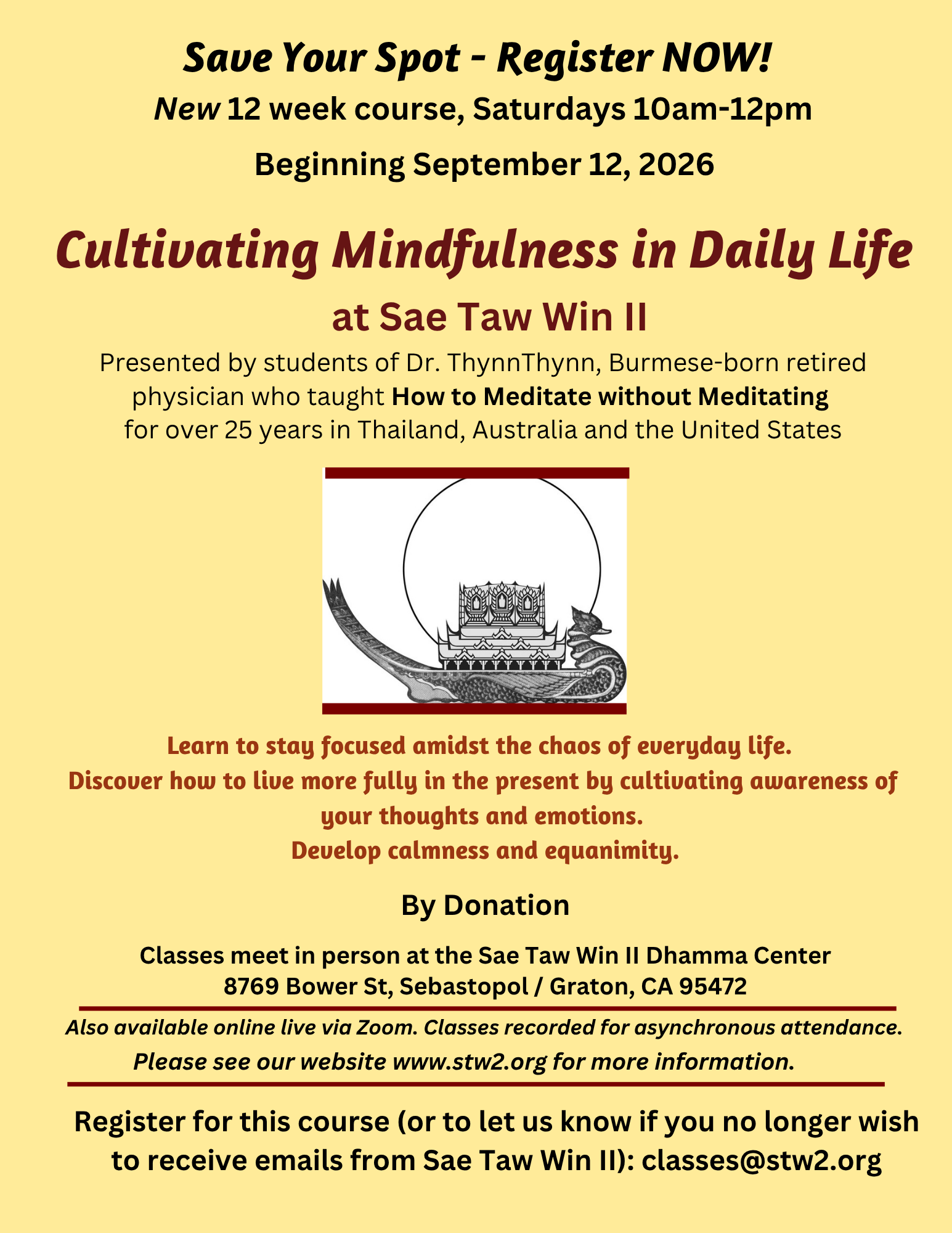
- Cultivating Mindfulness Class Flyer
- Conclusion
On Emptiness
Sheila Bare
This past Spring, our venerable teacher, Dr. Thynn Thynn, tasked all teachers to practice emptiness in our classes. “You must be empty,” she declared ardently, “for every student in class. You must be fearless.” I remember very well the expression on her face. She closed her eyes shut as she said it. I felt her passion and energy, and it moved me. So I took it upon myself to begin the practice.
My conditioning directed me to investigate further. What is Emptiness? I asked myself. I scoured the indices of my small collection of books on Buddhism, checked the World Catalog of books for extant texts, and, like anyone living in these modern times, scrolled the Internet. But whereas there were several sites on emptiness, most were from the Zen or Mahayana traditions. My search for Emptiness in the Theravada tradition came up – almost – empty! Pun intended. Some sites explained emptiness as a theoretical abstract notion: a chair is not a chair because it is empty of “chairness.” A koan, perhaps? A headscratcher, for sure. All these searchings outside myself led me down the rabbit hole.
And so I approached Thynn herself. “What exactly is emptiness?” I asked. “You think too much,” came her perennial reply to me. It’s something she had observed about me from the moment we met: “You think too much!” “But how do I practice it?” I insisted. She told me emptiness was a result of practice. And with her penetrating eyes, she turned the tables around. This was where the interviewer – me – became the interviewed, the source for the answer itself. “What would you say to a student? How would you practice it? How can it be sustained?” My own response was revealing: It cannot be sustained in any duration. It is a moment-to-moment practice of present-moment mindfulness, of bare attention. It requires me to unlearn all of what I’ve been conditioned to do, to think, to say in response to another. To leave behind the past and focus only on what is arising in the present moment. It is a practice of noting what arises without additional mental commentary. To be empty is perhaps one of the most compassionate practices, to be wholly present to another, without any preconceptions, without fear, without doubt, without past, and without future. To offer oneself up to another is to be vulnerable and so requires formidable strength. To be empty is to be attuned to and attend to, solely, on the present moment.
Further contemplation led me to connect emptiness with anattā, non-self, one of the three markers of existence. What is arising in the moment is not me. What I see as me or anything else—here, insert any noun or phenomena you wish (like a chair, for instance)—is an aggregate (khanda) of other forms, is a formation of the mind (saṅkhārā), and conditioned by and dependent on other factors coming together and then perceived or conceptualized in my own mind. All phenomena are empty because they are impermanent, they arise dependent on causes and conditions, and they disappear immediately after arising. As the Babylonian Talmud says, “We do not see things as they are; we see things as we are” (my emphasis). To see things as they are is to empty them of any preconceptions I have.
I recalled a mentoring session with Thynn that was most illuminating. In her usual practice of teaching in the Socratic method, she asked us and then explained:
How to experience the suchness of the moment, in its own state? The essence of the practice is letting it be and not act on your own emotions, not act on your mind states that arise because we all have defilements. How to manage our thought processes that arise in every moment? When we inject our judgments [. . .] greed, ill-will, delusion, that’s when we distort the world around us. We distort ourselves [. . .] and so we distort everything else around us. When you take away those defilements, then your experience is ‘as such,’ in its suchness, the suchness of your experience. When we come to the suchness of ourselves, of everything out there, we find that [. . .] it’s our own interjection into the process [. . .] that creates so much unhappiness, discord. To see things in their own suchness, in their own state, whether good, bad, everything else, decaying, regenerating, the whole world as it is.
“Empty. Sunnata.”
For More Information on Emptiness:
Bhikkhu Bodhi, Ed. Abhidhammattha Sangaha: A Comprehensive Manual of Abhidhamma. BPS Pariyatti Editions, 2012. “Thus in the Abhidhamma all such conceptual entities [. . . ] are resolved into [. . .] bare mental and material phenomena that are impermanent, conditioned, and dependently arisen, empty of any abiding self or substance” (6).
Olendzki, Andrew. Unlimiting Mind: The Radically Experiential Psychology of Buddhism. Wisdom Publications, 2010. “The core insight of the Buddhist tradition—the relentless emptiness of phenomena—has profound implications for all of us who are trying to understand the nature of life. It points to the disturbing fact that all nouns are arbitrary constructions” (131).
—. Untangling Self: A Buddhist Investigation of Who We Really Are. Wisdom Publications, 2016. “Consciousness can be seen as a series of brain events taking place within a natural ecosystem, but as events rather than entities they are intrinsically empty and interdependent.”
—. “Emptiness”, by Thanissaro Bhikkhu. Access to Insight (BCBS Edition), 8 March 2011, http://www.accesstoinsight.org/lib/authors/thanissaro/emptiness.html
What is Emptiness
by Thanissaro Bhikkhu
Emptiness is a mode of perception, a way of looking at experience. It adds nothing to and takes nothing away from the raw data of physical and mental events. You look at events in the mind and the senses with no thought of whether there’s anything lying behind them.
This mode is called emptiness because it’s empty of the presuppositions we usually add to experience to make sense of it: the stories and world-views we fashion to explain who we are and the world we live in. Although these stories and views have their uses, the Buddha found that some of the more abstract questions they raise — of our true identity and the reality of the world outside — pull attention away from a direct experience of how events influence one another in the immediate present. Thus they get in the way when we try to understand and solve the problem of suffering.
“Emptiness”, by Thanissaro Bhikkhu. Access to Insight (BCBS Edition), 8 March 2011, http://www.accesstoinsight.org/lib/authors/thanissaro/emptiness.html
Planning Ahead
Cultivating Mindfulness
We have completed the first year of the effort to restart the teaching program at Sae Taw Win II, insuring the continuation of Dr. Thynn Thynn’s Daily Life Mindfulness Practice classes. Many thanks to Daniel, Carol, Sheila and Doug for their dedication to this endeavor!
A new Cultivating class starts September 12 at 10 AM Pacific time and will run for 12 weeks – with breaks for the various holidays.
Registration for this series is open now: classes@stw2.org
New Fall 2026 Class for Advanced Students
Sae Taw Win II is currently planning the re-introduction of Advanced Study of the Satipatthāna Sutta–The Four Foundations of Mindfulness–slated for Fall 2026. This deep dive into the teachings of the Buddha are at the very heart of our Daily Life Mindfulness Practice.
It has been some years since this advanced class has been offered at STWII. In addition to opening this class to all who have finished the three basic courses: Daily Life Mindfulness, The Eightfold Path, and Bringing Harmony to Conflict, we’d like to invite those who have taken it before to consider revisiting the class again.
Dates are yet to be announced, but we’d love to hear from you: it’s never too soon for you to announce your intention to join Sheila Bare for this series! For more information or to register, please email classes@stw2.org
– Jane Sipe
A Mindful Way Forward
Doug Snow
Sae Taw Win II will be offering the twelve-week introductory course “Cultivating Mindfulness in Daily Life” this coming September 2026. The course follows the teaching method developed by Dr. Thynn Thynn. The class is grounded in Buddhist Theravada tradition and the Pali texts of the Buddha’s teachings.
Instead of relying on a lecture format, the course emphasizes in-class student participation and daily practice of course topics. Our goal will be to develop practical mindfulness skills that can be applied to the challenges of everyday life, including family relationships, the workplace, and personal growth.
This course introduces the fundamental teachings of Buddhism, including the Four Noble Truths, Four Foundations of Mindfulness and the Eightfold Path. The class topics will include guidance in daily practice of the following skills:
- develop the ability to remain present in the moment
- cultivate awareness of peaceful states of mind
- recognize and transcend likes and dislikes
- skillful attention to harmful value judgment
- observe and move beyond habitual attachment and clinging
In-person attendance at the Dhamma House in Graton is encouraged. Although, for those who are unable to attend in person, the course will also be offered live (and recorded) via Zoom. Recent online classes have allowed students from throughout the United States, Canada, and South America to participate from their homes.
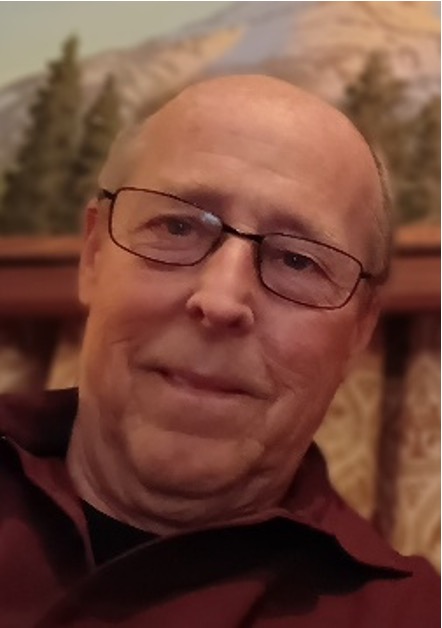
My name is Doug Snow, and I look forward to presenting the weekly class topics. I have been studying with Dr. Thynn Thynn since 2007. Before discovering the Sae Taw Win II teachings, my personal growth interests included sitting meditation, yoga, tai chi, volunteer work, and cognitive therapy. While each of these practices has helped support a healthy way of life, I have found the Sae Taw Win II program especially valuable in integrating and making sense of these efforts. This practice has also been a way for me to more consciously attend to life’s difficulties and joys in a heart-felt way. My mind is becoming more a helpful means, guided by a heart focused on gratitude and kindness as I navigate these challenging times.
If you would like to learn more about Sae Taw Win II and this course, Dr. Thynn Thynn’s book Living Meditation, Living Insight is a great place to begin. A free electronic edition is available on the Sae Taw Win II website (www.saetawwin2.org) and a Kindle edition can also be purchased through Amazon.
This twelve-week introductory course is an opportunity to develop a deeper understanding of practical mindfulness skills for everyday life while drawing on the wisdom of the Theravada Buddhist tradition. You can register for this class by sending email to classes@stw2.org.
Many thanks…
to former students who have (again) completed the basic three courses:
Miguel, Nona, Donale, Marti, Susan, Cynthia, Jim
Also acknowledging our new students:
Javi, Mark, Rene, Andy
Stop, Look, and Care
Be advised that this article mentions suicide and may not be suitable for everyone.
Andy Nguyen
My way of dealing with suffering has frequently been unskillful. I noticed it this week while mourning the suicide of a fellow doctor in Quebec. Many questions arose. Why would a doctor take her own life? What suffering could she no longer live with? What pain could she no longer heal? We won’t explore those, because I want to respect the rule that you don’t go where you cannot bring yourself or your reader back safely.
The Buddha says that when we suffer, we can determine the root cause of that suffering, which is clinging. He also taught a path for seeing that clinging clearly and learning how to let it go. I was using this path as I read a reflection written by another colleague. He wrote about his own experience with burnout and depression. He described one of the main strategies he had used during his medical training and in practice: Keep going.
Too tired? Keep going. Too sleepy? Keep going. Can’t sleep? Keep going. Too stressed? Keep going. Too numb? Keep going. Conflict at home or at work? Keep going. Whatever painful or difficult things the world throws at you: keep going. I recognized this strategy immediately. I have used it for years. I still use it. I just had never given it a name: keep going. Naming it felt powerful. I could suddenly see something that had been there all along. I think the strategy has real value. It is simple. When you are exhausted and feeling at the end of your rope, simple matters. But every tool has limits. I am grateful to my colleague for pointing out that this strategy contributed to his burnout and depression.
But why? There’s a famous psychology experiment involving seminary students. The students are told to walk from one building to another to give a sermon on the Good Samaritan. On the way, they pass a man lying on the ground, moaning. One group was told to go leisurely and the other group were told they were late and had to hurry. The question was: who would stop to help the suffering man? Not surprisingly, fewer students stopped when they believed they were late. They just kept going. This shows one of the dangers of “keep going.” Sometimes we rush forward and leave someone behind. And sometimes the person we leave behind is ourselves. A part of us is lying there, wounded, on the side of the road. But we keep walking. We abandon the part of ourselves that is suffering. I do not think we can live well that way. I say this because I have done it. I have left parts of myself behind. And I have carried the scars in my heart.
Through mindfulness practice in daily life, I can now see some of the results: suffering, disconnection from others, disconnection from myself, difficulty being present with my family, growing anger, hatred, confusion, and greed. Yes, greed. Greed for ease. Greed for well-being. Greed for solitude. Greed for inner peace. One thing I have learned is this: we cannot water the roots of greed, ill will, and delusion and expect generosity, love and wisdom to grow. Beneficial states of mind do not grow from greed, hatred, and confusion. There is another problem with “keep going.” As I keep going, I often carry an extra burden: the story that things should not be this way. I cling to the idea that there must be a better world, a world where the “too many things,” that need to be done, gets done. A world where some “x” wrong does not happen. But that clinging becomes another chain around my ankles. It makes the journey heavier. It adds more suffering to the suffering that is already there. So what is the way forward? When I do not know the answer, I try to remember what I have been taught: Stop. Look. Let it be.This week, I realized that I could stop and look at my own pain. I could stop, look, and take care of myself. I could say to myself: Yes, what needs to be done matters. Yes, I may still need to keep going. But I do not have to keep going while carrying the heavy burden of wishing the world were different. Instead, I can put down that burden. And I can pick up the wounded part of myself. I can carry that part in my heart. The part that is hurting. The part that walks more slowly because it is limping. Then we can keep going together. Not by abandoning myself, but with wholeness. With compassion. With kindness. With clear seeing. I know this is only a partial answer. It doesn’t answer the questions I asked at the beginning of this essay. But this is a path, not a destination. I am on a journey. I am learning not to ignore the parts of myself that I feel ashamed of. The parts I think are weak. The parts I left behind because I was in a hurry. Now, I am trying to stop, look, and care.
Click here to email classes@stw2.org.
This page intentionally left “Empty”